
Sofas for Small Spaces: The Measurement-First Guide
How to buy a sofa for a small space: measure the door, path, and wall first, then pick a size class — under 60, 60–72, or 72–80 inches — that truly fits.
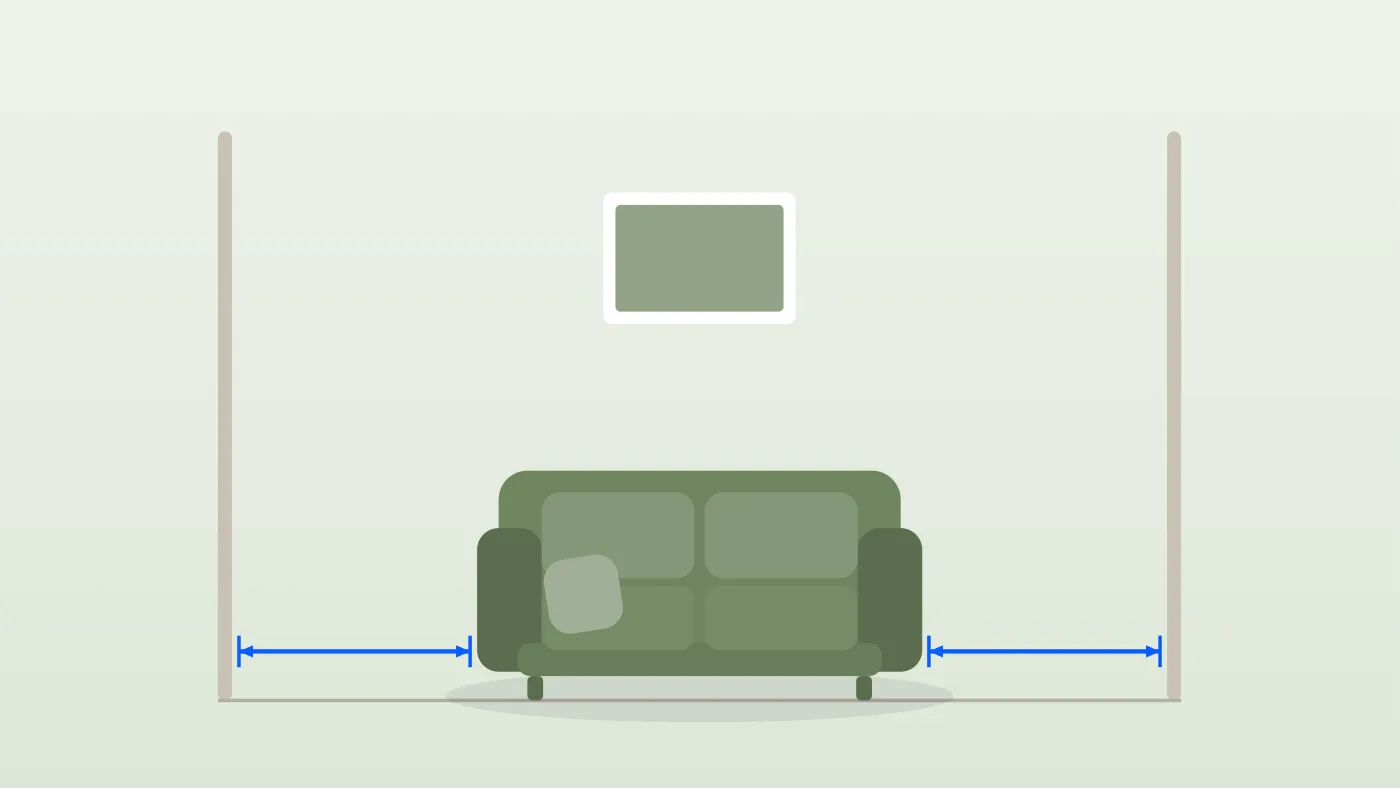
Buying a sofa for a small space is a measuring job with a shopping step at the end. Do it in the right order — door, path, wall, then seat — and the shortlist builds itself; do it in the shopping-first order and you join the long tradition of couches abandoned in stairwells.
What should you measure before sofa shopping?
Four numbers, measured in this order, decide everything:
- Door clear opening. Open the door fully and measure from its face to the opposite stop. A standard 32-inch interior door yields only about 30–31 usable inches; older buildings run tighter.
- The tightest turn. Measure hallway width at the sharpest corner on the route, plus any landing depth in a stairwell. Turns, not doors, kill most deliveries.
- Usable wall. Wall length minus vents, outlets you need, radiators, and door swings — then subtract 30–36 inches somewhere for a walkway.
- Seat depth for your legs. Sit with your back supported: if your knees bend at the seat edge around 20–22 inches, compact sofas will fit you; if you lounge cross-legged, you need 24-plus inches of seat, which small sofas rarely offer.
Write all four down before opening a single product page. Our sofa dimensions guide covers the technique in detail, and the Will It Fit tool turns your numbers into a pass/fail check per sofa.
What are the small-space sofa size classes?
Small-space sofas sort into three width classes, and naming yours cuts the market by ninety percent.
| Class | Width | Seats | Typical depth | Best for |
|---|---|---|---|---|
| Loveseat / compact | 48–60 in | 2 | 30–36 in | Studios, offices, bedroom seating |
| Apartment sofa | 60–72 in | 2–3 | 30–36 in | Most small living rooms |
| Compact full-size | 72–80 in | 3 | 32–38 in | One free wall, narrow room |
Two placement notes. A 72-inch sofa is a compact three-seater, not an oversized two-seater — it works in most apartments if the depth stays modest. And corners count as free space: a small L-shaped couch or a loveseat with a chaise seats more people per square foot than any straight sofa by using the corner a walkway cannot.
How does boxed shipping solve the doorway problem?
Boxed modular sofas make the door measurement almost irrelevant, because no single carton approaches door size. Burrow’s Nomad three-seater assembles to roughly 86 by 36 inches yet arrives in about five cartons near 40 pounds each; Lovesac Sactionals ship seat-by-seat; IKEA flat-packs work the same way. One person can carry every piece up a walk-up.
The trade-offs are visible seams, firmer foam, and assembly time measured in an hour, not an afternoon. For how modular systems compare with fixed sectionals, see the modular section of our types of sectionals guide.
How do you get a one-piece sofa through a narrow door?
Work the sofa’s smallest cross-section, not its width. Carried on end, what faces the door opening is the sofa’s depth or height — so a 34-inch-deep sofa with 4-inch screw-off legs can pass a 31-inch opening that its spec sheet says it cannot.
Three moves buy you inches: unscrewing legs typically saves 2–5 inches; lifting the door off its hinges adds roughly 1.5–2; and “hooking” — feeding the sofa through diagonally, back first — uses the hallway’s depth to beat the door’s width. If you are still within an inch after all three, order boxed instead of gambling on a restocking fee.
Which sofas earn their footprint twice?
In a small home, the best sofa does a second job. Storage sofas hide bedding or off-season clothes under the seats for no extra floor area. Sleepers add a guest bed — the mechanisms and their real mattress sizes are compared in our sleeper sofa guide.
The strongest space play of all is the murphy bed with a couch: a real mattress stored vertically behind a working sofa, so one wall serves as living room by day and bedroom by night. It costs more than either piece alone and needs stud anchoring, but nothing else replaces two rooms of furniture in one footprint.
What do you trade away with a compact sofa?
Mostly lounging depth. Compact sofas hold width down by shaving the seat to 20–22 inches and thinning the arms, which produces an upright, chair-like sit — fine for conversation and reading, cramped for movie sprawling. If deep lounging is the point of your evenings, give up width somewhere else and keep the seat depth.
Cushion count changes too: many small sofas use a single bench cushion, which looks cleaner and sleeps a guest better, but cannot be rotated to spread wear. Neither trade is a flaw; they are the terms of the class. If you are weighing a compact sectional against a sofa-plus-chair, our sectional vs sofa comparison runs that math.
Which small-space sofa should you skip?
- Skip anything over 36 inches deep. Depth, not width, is what makes small rooms feel furniture-stuffed — and deep sofas are the ones that fail doorways.
- Skip one-piece sleepers above a second-floor walk-up. The rigid steel piece is the classic stuck-in-stairwell purchase; boxed or fold-flat designs exist for a reason.
- Skip low cloud-style seats if anyone has bad knees. A 15–17-inch seat height that photographs beautifully is a squat workout every time you stand.
- Skip curved and bubble silhouettes. The arc wastes wall on both sides — the one resource you are shopping to conserve.
- Skip “apartment” labels without a spec sheet. The word is unregulated; only the width, depth, and carton numbers mean anything.
Ready to buy?
Take your four measurements, pick your class, then go straight to the measured round-ups: small L-shaped couches for corner layouts, loveseats with a chaise for lounging under 80 inches, storage sofas if closets are short, and the murphy bed with couch comparison if the living room moonlights as a guest room.
Frequently asked questions
Quick answers to what buyers ask us most
What size sofa fits a small living room?
Keep the sofa under about 75 inches wide and leave 30–36 inches of walkway on at least one side. In practice that means a 60–72-inch apartment sofa for most small living rooms, a sub-60-inch loveseat for studios, and a compact 72–80-inch three-seater only when one full wall is free. Depth matters as much as width — 32–36 inches deep keeps the room walkable.
Will a couch fit through a 30-inch door?
Often, but it is the tightest common case. A 30-inch clear opening passes any sofa whose depth or height — legs off — is 29 inches or less, carried on end. Deeper sofas must be hooked through diagonally, which needs hallway room on both sides. If the math is within an inch, choose a boxed modular sofa instead; every carton clears with room to spare. Run your numbers in our Will It Fit tool.
Is a loveseat or a small sectional better for a studio?
A small sectional wins when the room's seating has to serve lounging, guests, and TV from one spot — a compact L uses the corner a loveseat wastes. A loveseat wins when the delivery path is hostile or the sofa shares the room with a bed. Compare footprints in our small L-shaped couches and loveseat-with-chaise round-ups before deciding.
Do sofas in a box feel cheaper than regular sofas?
Not inherently, but they feel different. Modular boxed sofas trade a single sculpted silhouette for visible seams and firmer, higher-resilience foam that survives compression shipping. Mid-band boxed brands like Burrow hold up well in owner reports; the weak point is usually connection hardware loosening, not frames. If seams bother you, buy boxed only where the alternative is a sofa that cannot reach the room.