
Types of Sectionals: Every Configuration Explained
L-shaped, U-shaped, chaise, modular, curved, pit, and sleeper sectionals compared — typical footprints, doorway notes, and which one fits your room.
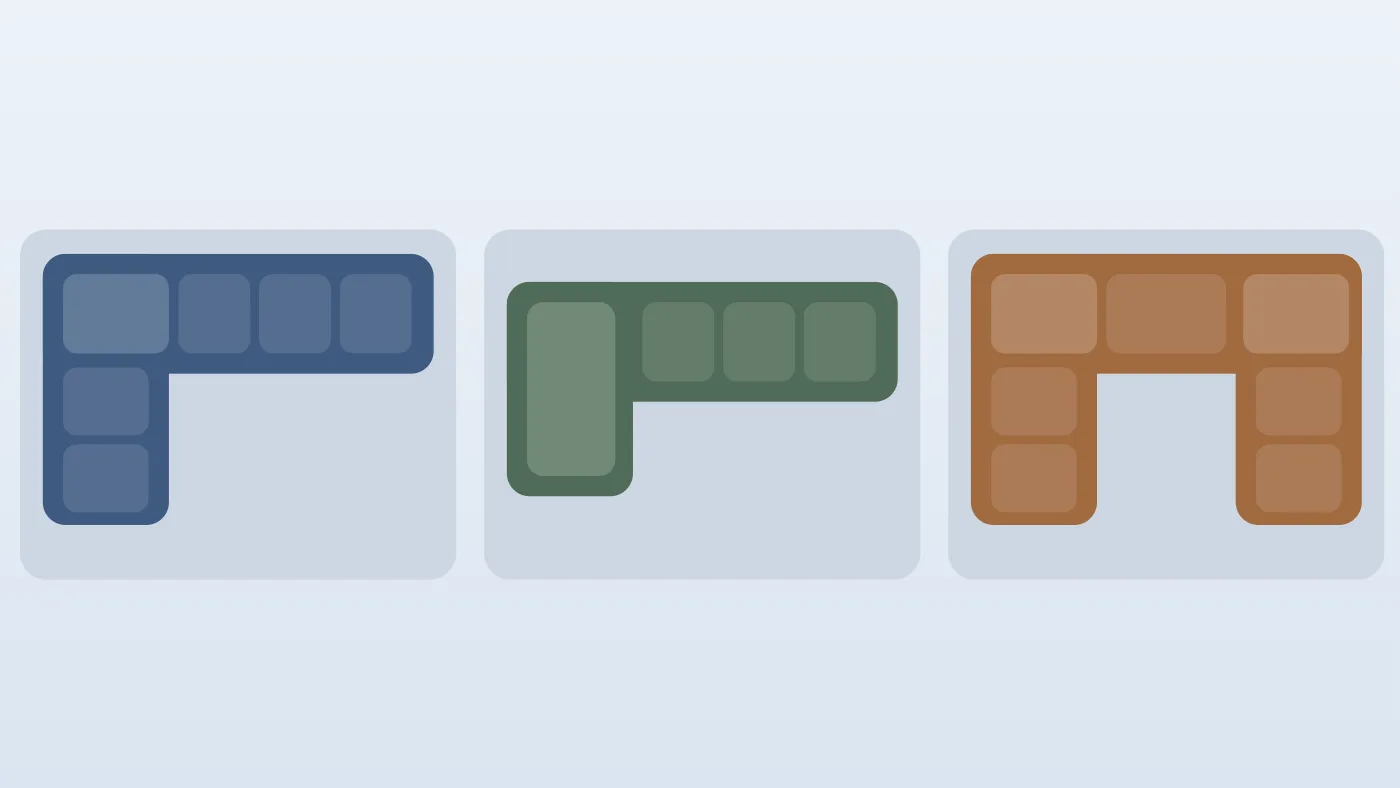
Every sectional on the market is one of seven configurations, and the configuration — not the brand — decides how much wall it needs, how it ships, and whether it can change shape later. Match the configuration to your room first; colors and fabrics come last. If you have not yet ruled out a regular three-seater, our sectional vs sofa comparison settles that question first.
What are the seven types of sectionals?
Seven configurations cover essentially everything sold as a sectional in the US. Footprints below are typical retail ranges, not extremes — always check the listed spec.
| Configuration | Typical footprint (W × D) | Doorway reality | Best for |
|---|---|---|---|
| L-shaped / corner | 95–130 in × 60–100 in | Ships in 2–3 pieces; each usually clears a 32-in door | Most living rooms |
| Chaise sectional | 78–112 in × 60–65 in at the chaise | Usually 2 pieces | Apartments, one-wall rooms |
| U-shaped | 110–140 in × 60–100 in | 3+ pieces | Big family rooms, 10+ ft of wall |
| Modular / reversible | Built from ~28–40-in units | Every carton clears a standard door | Renters, movers, odd rooms |
| Curved | 90–120 in × 40–90 in | Often one piece — measure first | Open floor plans |
| Pit / cloud-style | 100–130 in × 70–90 in | Modular pieces, huge assembled footprint | Movie rooms, floor loungers |
| Sleeper sectional | 84–100 in × 60–90 in | Heavy mechanism piece is the choke point | Guest-hosting apartments |
What is an L-shaped sectional?
An L-shaped sectional is a sofa run plus a shorter return leg meeting at a corner seat — the default configuration in American living rooms. Most are “RAF” or “LAF” (right- or left-arm-facing), which fixes which way the L points, so confirm the orientation against your wall before ordering.
Because the two legs ship separately, L-shapes are easier to deliver than their assembled size suggests. Compact versions exist well under 80 inches per side; we measured the category in our small L-shaped couches guide.
What is a chaise sectional — and do you actually need one?
A chaise sectional replaces the return leg with an open lounging cushion, which reads as a sectional while using barely more floor than a sofa. It is the right call when you want legs-up lounging against one wall, and many models let you swap the chaise side during assembly.
Two cheaper substitutes deserve a look first. A sofa with a matching ottoman does the same job and moves out of the way for guests, and a loveseat with a chaise delivers the shape under 80 inches for small rooms.
What is a U-shaped sectional?
A U-shaped sectional adds a second return leg, wrapping three sides of a coffee table for five to six sitters. The cost is wall: IKEA’s 6-seat Vimle U-shape runs about 129 inches wide with legs reaching roughly 98 inches into the room, and that is a mid-market example, not an outlier.
Plan for ten feet of unbroken wall, plus a walkway that neither leg blocks. If you want this scale with extra seat depth, the extra-deep models in our oversized sectionals guide are measured for exactly that.
What is a modular or reversible sectional?
A modular sectional is built from interchangeable units you assemble yourself, so the same purchase can be an L-shape, a U-shape, or two small sofas. Lovesac Sactionals are the reference design: seat units around 35 by 29 inches and 18 inches tall, with 6-inch-thick side and back panels you reposition — and every piece arrives boxed, which is why modulars are the one full-size sectional that never gets stuck in a stairwell.
“Reversible” is the budget cousin: a chaise cushion you can move to either end rather than true modularity. Both suit renters who move often; see how boxed shipping changes small-space delivery in our small-space sofa guide.
What is a curved sectional?
A curved sectional bows in an arc instead of meeting at right angles, which looks striking from every side but wastes the space behind the curve — a 100-inch curved sofa can need close to nine feet of wall while seating no more people than an 84-inch straight one. Many also ship in one piece, making them the configuration most likely to fail at the door.
They shine floated in open plans, not pushed to a wall. We size the category, arc by arc, in our curved and circle couches guide, and the rounded, cartoonish end of the trend gets its own treatment in bubble couches.
What is a pit sectional?
A pit (or cloud-style) sectional fills its interior with backless modules so the whole footprint becomes mattress-like lounging. The style RH Cloud made famous runs on roughly 40-inch-deep modules — resale listings put a 3-piece sofa around 119 by 40 inches and a 5-piece pit near 118 by 80 inches — so a true pit claims as much floor as a queen bed.
Pits reward households that watch movies in a heap and punish anyone who wants upright, get-up-easily seating. Shop the category through our best oversized couches and cuddle couches round-ups, both measured for depth.
What is a sleeper sectional?
A sleeper sectional hides a fold-out or pull-out bed inside one leg, usually pairing it with storage under the chaise. IKEA’s Friheten is the pattern’s best-known example: about 90.5 by 59.5 inches assembled, opening to a sleeping surface IKEA lists at roughly 55 by 80 inches — longer than most American pull-outs — with a lidded storage bin in the chaise.
The mechanism piece is heavy and rigid, so check its shipping dimensions against your door, not the assembled size. Mechanisms, mattress sizes, and what breaks are covered in our sleeper sofa guide; if guests stay weekly rather than yearly, a murphy bed with a couch beats any fold-out, and dedicated storage sofas solve the stash problem without the bed.
Which sectionals work for offices and gaming rooms?
Waiting rooms and studies want tight, upright seating — usually compact L-shapes or armless modulars in wipeable fabrics — while media rooms want depth, recline, and cupholders. We split those briefs into two dedicated round-ups: office couches for client-facing spaces and gaming couches for console and PC setups.
Which sectional type should you skip?
Match these against your room before falling for a photo:
- Skip U-shaped if you have under ten feet of clear wall — it will block a doorway or a walkway, guaranteed.
- Skip curved in narrow or corridor-shaped rooms; the dead zone behind the arc is space you paid for.
- Skip pit-style if anyone in the house needs firm, upright seats to stand up from.
- Skip sleeper sectionals for nightly use; fold-out mattresses are guest-grade, and a murphy-couch combo sleeps better.
- Skip fixed L/R-arm pieces if you move often — that orientation may not fit the next apartment. Go modular instead.
How do you choose the fabric and color?
Decide cleaning code before color: a W or W-S code fabric survives real cleaning, and our sofa materials guide decodes every family from performance weaves to velvet sectionals. Light neutrals are the riskiest, best-loved choice — we test what survives in cream couches and white sectionals — while tan leather trades stain worry for patina.
Saturated color is having a run: see our curated green sectionals and teal sofas picks before settling for gray.
When should you buy a sectional?
Holiday cycles are real: Memorial Day, Labor Day, and especially late November move sectional prices by meaningful margins, and we track the last of those live in our Black Friday couch deals tracker. Whatever the date, measure first — run your door, path, and wall through the Will It Fit tool and the sofa dimensions guide before any checkout page sees your card.
Frequently asked questions
Quick answers to what buyers ask us most
What is the most popular type of sectional?
The two-piece L-shaped sectional with a chaise is the configuration most US retailers sell most of, because it seats three to four people while ending in a leg you can walk past. It also ships in the fewest, smallest pieces of any full-size configuration, which keeps delivery simple. Start with our small L-shaped picks if your room is tight.
Can you separate a sectional into two pieces?
Only if it was built that way. Most L-shaped and chaise sectionals split into two or three connected pieces for moving, but the pieces rarely stand alone as finished sofas because connecting sides are unupholstered. True modular sectionals — Lovesac Sactionals and similar systems — are the exception: every seat is finished on all sides, so you can rebuild them into new shapes.
Will a sectional fit through a standard door?
Usually yes, because sectionals ship in pieces, and each piece is narrower than a one-piece sofa. The risk pieces are sleeper sections with steel mechanisms and one-piece curved sofas. Measure your door's clear opening — most US interior doors give you 30–31 usable inches — and check each shipping piece, not the assembled size. Our dimensions guide walks through it.
What is the difference between a sectional and a modular sofa?
Every modular sofa is a sectional, but not every sectional is modular. A standard sectional has fixed left-arm and right-arm pieces that only assemble one way. A modular sofa is built from interchangeable same-size units, so the same purchase can be an L-shape this year and a pit or two smaller sofas the next. You pay for that flexibility in visible seams and per-module cost.