
Sofa Dimensions Guide: Will It Fit Through the Door?
Standard couch dimensions, boxed carton sizes, and the diagonal-depth trick that decides whether a sofa clears your door, hallway, or stairs.
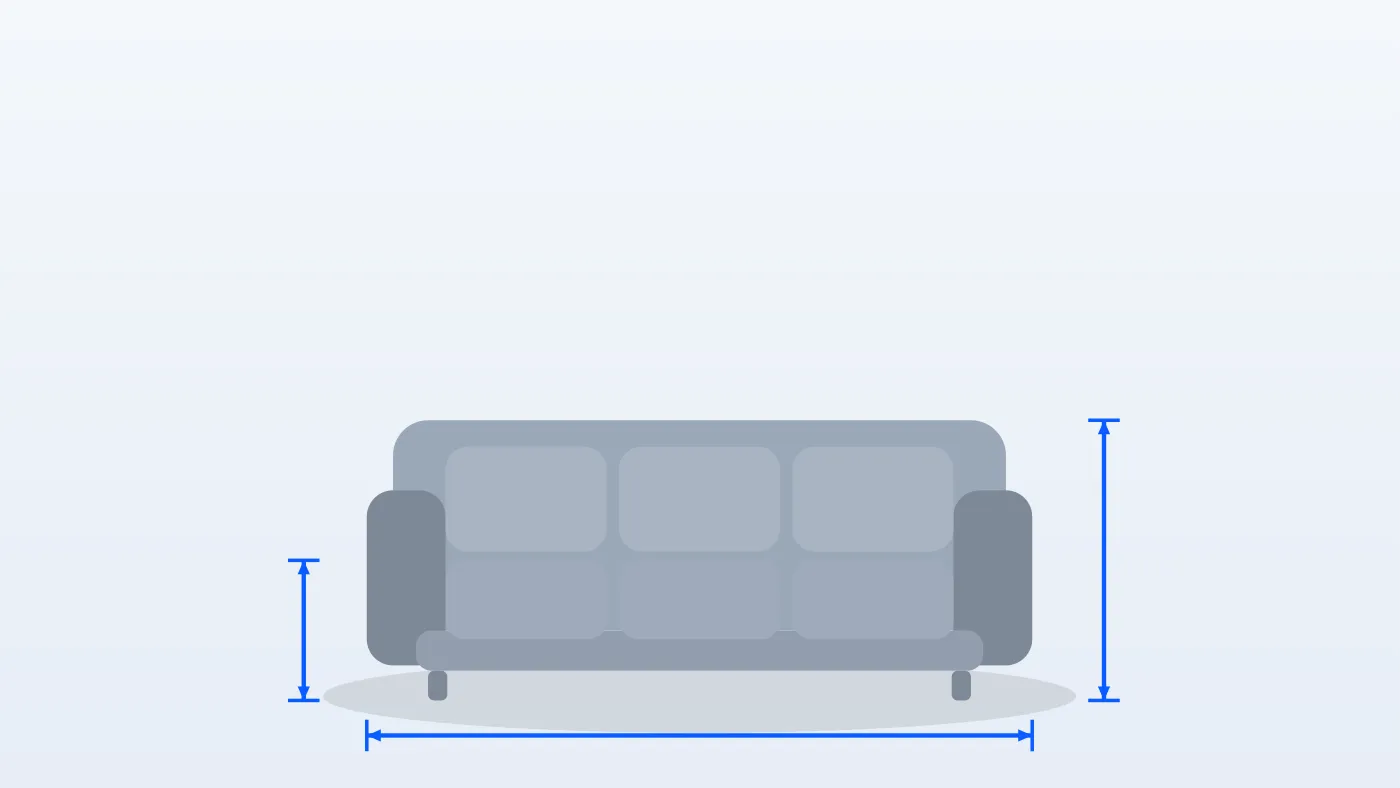
Most sofas that get stuck were never going to fit, because the buyer measured the wall and skipped the door. A couch has to clear three checkpoints: the room, every opening on the delivery path, and — if it ships flat — the carton stack. This guide gives you the standard ranges, then the exact method we run on every sofa we test. If you want the shortcut, our Will-It-Fit checker does the math from your measurements.
What are standard couch dimensions?
A standard three-seat sofa measures 84–90 inches wide, 35–38 inches deep, and 30–36 inches tall. Loveseats drop the width to 52–72 inches, and sectionals stretch to 95–130 inches on the long side. Depth and height barely change across categories — which is exactly why doorway trouble surprises people who assumed a smaller sofa would carry in easier.
| Type | Width | Depth | Height | Seat depth |
|---|---|---|---|---|
| Loveseat | 52–72” | 32–38” | 30–36” | 20–24” |
| Apartment sofa | 68–80” | 32–36” | 30–36” | 20–23” |
| Standard 3-seat sofa | 84–90” | 35–38” | 30–36” | 20–24” |
| Oversized / deep-seat sofa | 90–100”+ | 40–48” | 30–36” | 25–30” |
| L-shaped sectional | 95–130” (long side) | 58–70” (return) | 30–36” | 21–26” |
| U-shaped sectional | 120–160”+ (across) | 60–70” (returns) | 30–36” | 21–26” |
Seat depth is the comfort number: 20–24 inches suits upright sitting for most bodies, while 25 inches and up is lounging territory. If the deep end is what you want, our best oversized couches list has measured 25-inch-plus seats, and the types of sectionals hub sorts every configuration by footprint.
How do you measure a sofa before you buy it?
Take four numbers from the spec sheet or the sofa itself: width (arm to arm), depth (front edge to back), height (floor to top of back), and diagonal depth. The first three are printed on every listing. Diagonal depth usually is not — and it is the one that decides tight deliveries.
To measure diagonal depth, lay a straightedge from the top of the backrest to the front of the arm, then measure from the bottom back corner of the sofa to that line. For a quick estimate off a listing, square the depth, square the height, add them, and take the square root. That estimate treats the sofa as a solid block, so it runs slightly high — if the worst-case number clears your opening, the real sofa clears it too.
Will your couch fit through the door?
A couch fits through an opening when at least one of its cross-section numbers — depth, height, or diagonal depth — is smaller than the opening’s width. Sofas travel on end or tilted on the diagonal, so the 90-inch width that dominates the listing rarely matters at the door. Most modern US interior doors measure about 32 inches wide, exterior doors commonly 36, and older homes drop to 28–30.
The door is also not where most deliveries die. Delivery crews report that sofas usually clear the doorway, then jam on the turn into a narrow hallway, a stair landing, or an elevator cab. Measure hallway widths, ceiling height above stair turns, and the elevator’s door and cab depth — not just the front door.
If the numbers land within an inch or two, there is still margin. Unscrewing the legs typically buys 4–6 inches, and lifting a door off its hinges adds another 1–2.
What is the four-step will-it-fit method?
Run this check before you order, in this order:
- Measure the sofa. Width, depth, height, and diagonal depth — or the carton dimensions if it ships boxed.
- Map the path. Every door width on the route, hallway widths, stair landings and ceiling pinch points, elevator door and cab depth.
- Compare. Put the sofa’s two smallest numbers — usually depth and height — against the tightest opening. If either clears it, the sofa passes flat or on end. If neither does, check diagonal depth against that same opening.
- Plan the move. Legs off, cushions out, sofa wrapped, two carriers — and the door off its hinges if you are inside two inches of the limit.
Our Will-It-Fit tool runs steps 1–3 for you and flags the exact pinch point on your path.
How big are boxed sofa shipping cartons?
Boxed sofas exist to make the doorway question disappear: each carton is sized to pass a standard 30–32-inch opening. Burrow lists a three-seat sofa with ottoman at five cartons of roughly 40 pounds each, and Albany Park publishes Kova corner cartons at about 44 x 44 x 15 inches — bulky, but flat enough to turn a stair landing. IKEA flat-packs run smaller still. Carton counts change with configuration, so check the shipping tab on the exact listing.
Assembled delivery is the opposite bet. Traditional retail sofas arrive full size and have to clear every opening, and a 40-inch-deep module will not pass a 36-inch door in one piece — a big reason boxed cloud couch dupes took over that market. Sleepers deserve extra caution too: the folded steel mechanism makes them heavier and boxier than a same-width sofa, as our sleeper sofa guide explains.
How much clearance does a couch need inside the room?
Leave 30–36 inches for walkways, 14–18 inches between the sofa and the coffee table, and 3–4 inches between the sofa back and the wall. A main path through the room wants the full 36 inches; a squeeze between two furniture pieces can drop to 30.
As a proportion check, keep the sofa at or under about three-quarters of its wall’s length. If the open question is one big piece versus a sofa plus chairs, our sectional vs sofa comparison works that math room size by room size.
Who should NOT trust standard dimensions?
Standard ranges describe new-construction homes and current mass-market sofas. Measure everything yourself if any of these apply:
- Pre-1950s houses. Interior doors of 28–30 inches are common, and trim narrows hallways further.
- Walk-up apartments. Switchback stairs with low ceilings beat door width as the real pinch point.
- Basement rooms. Stair ceilings and bottom landings stop more sofas than any doorway does.
- Elevator buildings. The cab’s depth and door width are the true gate — measure both, and the lobby turns.
- Deep-seat shoppers. Past 40 inches of depth the normal rules flip; insist on boxed shipping or a verified diagonal depth.
- Vintage and estate buyers. There is no spec sheet — measure the piece itself, diagonal included, before paying.
Which couch should you shop once the numbers work?
Settle the shape first, then the material, then the model. Start with sectional vs sofa for the room-size decision, read leather vs fabric before you commit to a cover, and check how long couches last to pick a construction tier worth the money. Ready to buy? Deep-seat loungers should start with our best oversized couches, and tight rooms with our small L-shaped couches that actually fit.
Frequently asked questions
Quick answers to what buyers ask us most
What are the dimensions of a standard 3-seat couch?
Most three-seat sofas measure 84–90 inches wide, 35–38 inches deep, and 30–36 inches tall, with a seat depth of 20–24 inches. Apartment-scale versions trim to 68–80 inches wide. Always check the listed spec rather than the category average — depth is the number that decides both comfort and whether the sofa clears your door.
What is diagonal depth on a sofa?
Diagonal depth is the sofa's tightest tilted cross-section — the number delivery crews use when a piece has to angle through an opening. Measure it by laying a straightedge from the top of the back to the front of the arm, then measuring from the bottom back corner to that line. If diagonal depth is smaller than the door width, the sofa can pivot through.
Will a couch fit through a 30-inch door?
Often, yes — carried on end with the legs removed. A sofa clears a 30-inch opening when its depth, height, or diagonal depth is under 30 inches, and removing legs typically saves 4–6 inches. Deep-seat sofas of 40 inches or more usually will not make it assembled; for those, boxed modular shipping is the reliable route.
How big is the box a sofa ships in?
Boxed sofas split into several cartons sized for standard doorways. As published examples, Burrow lists a three-seat sofa plus ottoman at five cartons around 40 pounds each, and Albany Park lists Kova corner cartons near 44 by 44 by 15 inches. Counts and sizes change by configuration, so read the shipping tab on the exact listing before ordering.
What size couch fits a 12-by-12 room?
A 72–84-inch sofa or a compact sectional up to roughly 100 inches on the long side fits a 12-by-12 room while preserving 30–36-inch walkways. Keep the sofa at or under about three-quarters of its wall length, and leave 14–18 inches to the coffee table. Bigger than that, and circulation — not style — becomes the daily problem.